
Putting the ‘Relationship’ Back Into CRM
Many managers think that the way to capture value through relationship marketing is to focus on the ‘good’ customers and get rid of the ‘bad’ ones. But there is a lot more to best practice relationship management than maximizing revenues on individual customers and minimizing costs to serve.
Topics

Image courtesy of Flickr user **Maurice**.
Over the past two decades, managers have become enamored of relationship marketing. Lured by the opportunity to use customer data to build customized and profitable relationships, companies have invested heavily in customer relationship management systems that quantify the value of transactions. This interest shows no signs of tapering off. A recent Gartner Inc. research study showed that 75% of managers planned to make further investments in CRM in the coming year.1 However, most CRM systems have been used merely to categorize customers into segments based on their current levels of profitability. This approach may have implications for the bottom line, but it does little to advance the shift from mass marketing to one-to-one relationships. Customer relationship management has devolved into customer profitability management, a one-dimensional, company-centric practice based on economics and costs that provides little insight into why and in what ways people form relationships with companies and brands. That lack of relationship sensitivity has precipitated a new trend in which many companies use their CRM systems to identify and “fire” low-revenue, high-cost customers. In a recent survey we conducted of 900 customers, 30% said that they knew someone who had been cut loose by a company with which they had a commercial relationship. We are not so naïve as to think that companies should refrain from analyzing customer’ purchase data or the efficiency of marketing dollars spent. However, we have found that basic information about customer lifetime value can be a limited and even misleading indicator of the status and potential of a customer relationship. Loyalty programs, the most basic type of CRM program, do surprisingly little to address relationship realities or build relationship bonds. Although CRM programs may prevent customers from taking their business elsewhere, they are less effective at identifying the reasons to encourage them to stay. Ironically, CRM programs themselves may actually contribute to the creation of high-cost, low-value customers. However you look at it, companies are doing something wrong.
The Leading Question
How can companies build better relationships with their customers?
Findings
- Get to know who your customers really are and what they need and value.
- Be open to the different types of relationships that people form with your company and your brand.
- Recognize that relationships can’t be one-sided; accept responsibility for difficulties.
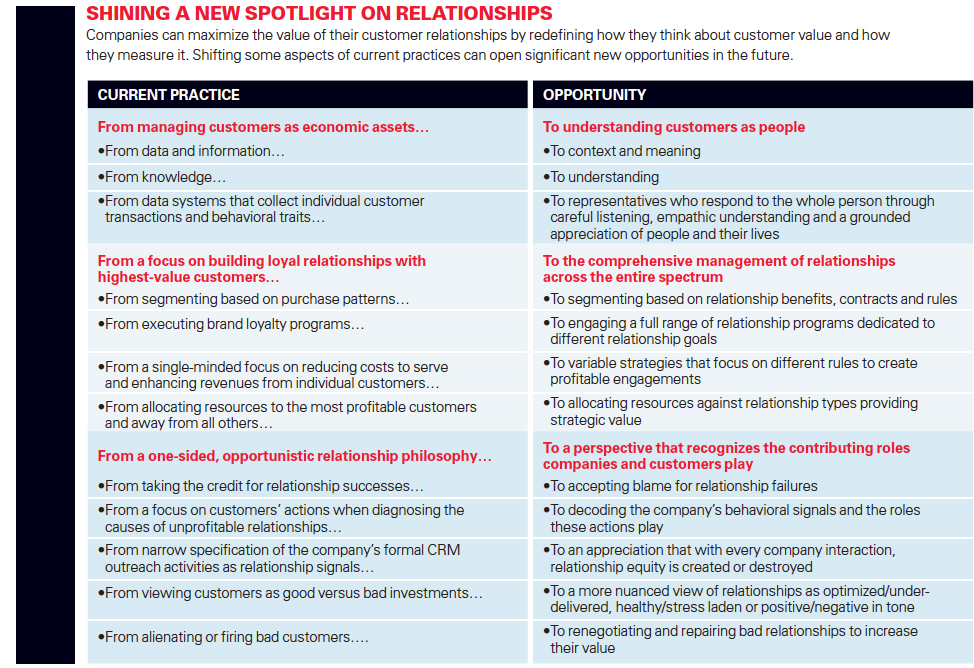
A dramatic shift in perspective is required, yet for managers who are willing to think more deeply about the relating part of CRM and their own roles in creating or destroying value, significant opportunities are available. (See “Shining a New Spotlight on Relationships.”) By attending to the “R” in CRM, good relationships can be improved, and bad relationships can be turned around.
Refocusing on the Relationships in CRM
In an effort to develop a deeper understanding of consumers’ relationships with brands and companies, we studied people who were in emerging, existing and terminated relationships. (See “About the Research.”) Our research has led us to identify three important ways in which the current practice of CRM fails. First, companies seem to forget that their relationships are not just with consumers but with people: people who live rich and complicated lives. CRM programs rely on purchase information and do little to address deeper relational needs. Second, because relationships come in different shapes and sizes, companies need to be cognizant of the requirements of diverse types of relationships beyond the loyalty ideal. Different relationships require different ways of relating, and managers must adapt their CRM programs accordingly. Finally, companies don’t recognize that relationships are two-sided and that these relationships evolve with each interaction. As much as managers like to claim credit for profitable relationships, they also need to be willing to look inward to learn why relationships break down. By failing to treat relationships as dynamic works in process, companies walk away from relationships that could generate significant value.
The First Principle: Get to Know Customers as People
Contemporary CRM systems look at customers as “consumers,” monitoring their purchase histories and calculating costs to serve. Although metrics such as acquisition and retention costs, cross-selling potential and customer lifetime value provide economic insights that can advance the company agenda, they overlook the fact that the customer is first and foremost a person into whose life a meaningful brand may come. There is a big difference between a system that’s attuned to purchase and demographic data and one that takes into account what individual consumers are feeling, what they value and how they conduct their days. You can know a purchaser by collecting purchase and demographic data, but to establish a relationship you really need to understand what makes the person tick. At issue is the distinction between having information and constructing meaning. Having information involves disintegrating and reducing complex ideas into small, manageable bites. But finding meaning involves assembling information bites into larger, more abstract wholes. Ironically, information and meaning tend to work at cross-purposes: For meaning, context is everything; with information, context is noise. Unfortunately, today’s CRM systems, designed by information technology professionals, are optimized for information management. They do little to help managers decode how the brand fits in the person’s life.
To appreciate the importance of deploying CRM systems capable of finding meaning, consider the way Peapod, the U.S. Internet grocer that is a subsidiary of Royal Ahold NV, treated a 50-year-old customer we’ll call Brenda. Brenda had an extremely busy schedule that involved working full-time at a local college, completing academic work for her undergraduate degree, and becoming the guardian of her grandson upon the death of her daughter. Discovering Peapod was a “lifesaver,” allowing her to order groceries online so her husband could pick them up at a nearby store in the course of his day. Every 10 days or so, she placed a new order. By month two, she was “hooked” and had stopped using other grocery stores altogether. As Brenda explains, “It was a contract of help. If all goes well I get from here to there with food in the fridge and nothing tipping over.”
But six months after signing up, the honeymoon came to an abrupt end. With no advance notification, Peapod changed its grocery pickup policy, requiring Brenda to drive to a different location a half hour further from home. She first learned of the change at 1:00 one morning when she tried to schedule an online order for pickup; the company replied, “unable to process request.” Brenda felt “betrayed.” She was doing all she could do to juggle multiple responsibilities under challenging circumstances, and now Peapod was suddenly changing the rules. “It’s like the companies you see in the news that close their doors, and when the workers show up there’s no jobs for them,” Brenda said. In her view, the company should have understood how important it was for her to have a pickup location that was nearby. After all, Brenda had provided Peapod with extensive personal data online and had engaged in countless interactions with the company during which she had divulged many details about her personal life. Perhaps even more distressing was that Peapod hadn’t bothered to tell her about the planned change in the business model. “We talk all the time and they could not pick up the phone and call me? You don’t treat people you care for this way.” Weeks later, when she received a $25 coupon toward her next purchase, Brenda was both insulted and deeply disappointed. Her feeling was, “Don’t throw money at me. Show me I matter. Admit you screwed up.”
The reality is that individual context significantly shapes a person’s brand relationships. Contextual clues may be scattered, but if a company pays attention, it can leverage them to build stronger relationships. Of course, companies need to be listening for the right kind of “data.” Any company with a CRM budget can collect and manage purchase data and calculate costs to serve. But to achieve differentiated advantage, companies need more robust data to assemble a more complete story of people’s needs and expectations, and how the brand helps them live their lives. Developing this understanding involves scanning for, listening to and interpreting the subtle signals that customers send during transactions.2 Companies such as Maine retailer L.L. Bean and American Express train customer service reps to capture notes about customer interactions and to convert the information into a broad contextual understanding. L.L. Bean representatives often recommend particular purchases based on specific information that the customer supplies (for example, that her son is really rough on his shoes). Marriott International’s Ritz-Carlton operates a system called “Mystique,” which collects staff observations about guests — everything from the kinds of fruit left on room-service plates to a guest’s oncoming cold.3 By adding contextual data obtained when talking with customers or when shadowing purchasers through service interactions or store visits, companies can expand their customer understanding and improve CRM.
However, true understanding involves more than just developing insights that are specific to purchase and consumption. It also means developing empathy for the individual’s broader emotional life and understanding how an experience feels from the customer’s perspective. Consider a second Peapod user we’ll call Virginie, a single, professional woman in her early 30s who disliked grocery shopping so much that she often had no food in her kitchen. The opportunity to order groceries online was, in her words, “beyond attractive”; before long she was placing orders almost every week. Yet Virginie also harbored concerns about privacy and safety: The fact that strangers were picking out her groceries, coming into her home and sometimes making comments about items she purchased made her uncomfortable. In addition, Peapod persisted in offering Virginie incentives that reinforced her fears (“We noticed it’s been awhile since you ordered; here’s a coupon for $25 off”). When a deliveryman asked to use her bathroom, that was the last straw. In Virginie’s view, Peapod broke an unspoken rule of their relationship, a rule the company was oblivious to because it neglected to consider her emotional life. Her concerns were never uncovered in Peapod’s consumer research.
How could Peapod have known about Virginie’s concerns for privacy when she didn’t discuss them directly with anyone during their various interactions? It wasn’t that Virginie was unwilling to talk about her experiences; she shared her stories freely with us on multiple occasions. Rather, Peapod didn’t bother to ask. Recognizing the inherent risks of being in the dark about things customers care about, some leading companies employ innovative market research methods to probe hidden concerns. Harley-Davidson, the Wisconsin-based motorcycle manufacturer, has professional ethnographers on contract who live the Harley lifestyle. The company requires executives to spend time in the field so that they can internalize deep insights about people’s experiences.4 Procter & Gamble relies on a market research tool called ZMET, a patented technology for mapping the deeper metaphoric meanings of brands;5 narrative analysis provides yet another tack. Other companies are experimenting with emerging technologies that offer tantalizing possibilities for decoding people’s experiences. For example, semantic Web applications use intelligent agent software to crawl through reams of information collected internally by the company’s CRM system or externally from the Web. Whatever the method, managers who are serious about understanding their customers need to find ways that go beyond analyzing purchase data to illuminate people’s lives.
The Second Principle: Think Beyond Loyalty
Today’s CRM systems recognize that there are different kinds of customers, and not all them are created equal. But in basing market segmentation on costs and lifetime values, companies fall into the trap of building strategies on relationship outcomes rather than on the inputs that create customer value in the first place. Research has shown that people form many different types of relationships with brands.6 We have developed a map of 18 different types of brand relationships. (See “The Landscape of Brand Relationships.”) Some relationships are deep and long lasting; others are superficial and fleeting. Some address emotional or social needs; others are more utilitarian. Relationships can be hierarchical or equal in terms of power; they can be positive or negative in tone. Although the range of brand relationships is quite varied, most companies focus on loyal “brand marriages,” despite the fact that there are several other types of emotionally vested loyal relationships, including “best friendships,” “addictions” and “flings.” Rather than focusing narrowly on marriages, companies have significant opportunities to build incremental value by focusing on and adapting their strategies to the relationship types that are best suited to their brands.
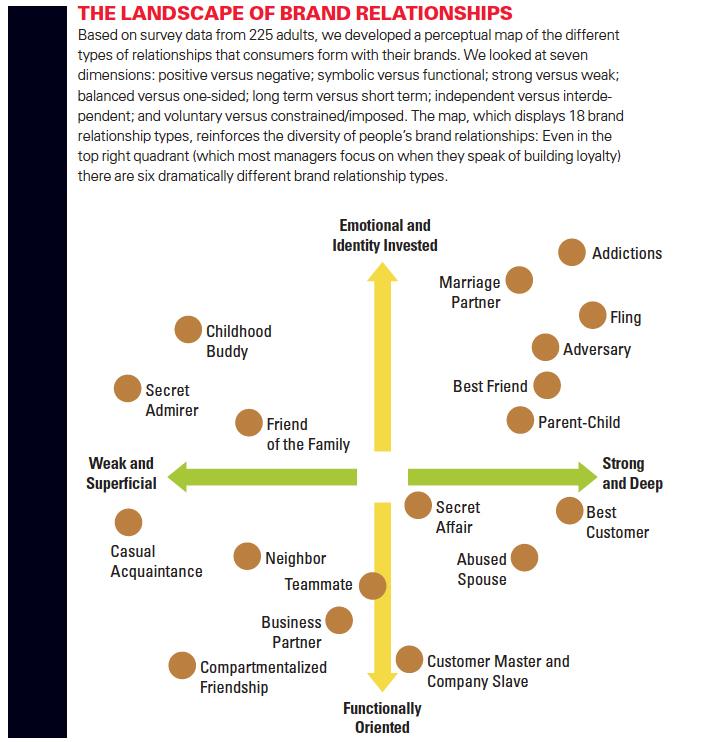
We have found that there is profit potential in many different types of relationships; the trick is to understand the specific relationship contract. Relationship contracts establish both the norms and the terms for the relationship, and they also signal what companies must do (and not do) to keep the relationship sound. Contracts also govern the potential economic rewards, as different types of contracts require different amounts of time and resources. We studied contracts of nine commercial relationships. Although “best friendships” and “marriages” occupy similar emotional space, they follow fundamentally different relationship rules: A marriage is a socially supported contract to stay together regardless of the circumstances; a best friendship, by contrast, is based on mutual interests and is voluntary. Marriages turn on commitment, love and fidelity; best friendships are built on intimacy and reciprocity. Marriage partners erect barriers to exit and consider it within bounds to try to change the other — actions that violate the core principles of friendship.
For many years, Harley-Davidson attempted to nurture brand loyalty through marriages with its customers. However, management discovered that a more appropriate and strategically attractive relationship goal was to build best friendships, which it saw as more aligned with the spirit of the brotherhood that defined the company’s culture. This shift dictated new rules of engagement, which have guided Harley employees’ interactions with customers: “Friends are equals: never support or convey hierarchies of power or control…. Never convey that you do not know or understand the other, as this calls into question the very intimacy upon which the friendship is based…. Never share information with others that the friend shares in privacy with you…. Be there when you are needed, for whatever reason.”7 The new guidelines have had ripple effects on everything from direct marketing communications to program offerings, training programs for community field officers and the types of customer databases in development.
Our research has helped us develop a clearer understanding of the guiding norms for other categories of relationships as well. For example, “best customers” like to see themselves as special and expect to be treated that way; they often have a biased accounting of the relationship, believing that they generate more profits than they actually do. With “flings,” individuals want to keep the emotional rewards high, which requires that companies find ways to maintain the excitement. “Partners,” on the other hand, can be expected to make compromises and accommodations to achieve goals that benefit both themselves and the company.
Given the array of relationship categories, what can leading companies do to negotiate and manage more profitable relationships with customers? First, managers need to have a good picture of the types of relationships in their customer portfolios. CRM software and the customer data that feed it offer limited guidance on how to maximize value creation across different types of relationships: Most companies simply end up shifting resources away from customers with less revenue potential or high costs to serve to their more profitable customers. But that is far too simplistic. To achieve real impact, managers need to know the types of relationships in their customer portfolio and the relative number of each type. This information will allow them strategically to select relationship segments, design programs and interaction protocols sensitive to the rules of each governing contract and allocate resources appropriate to maintenance and growth.
The Third Principle: Take Responsibility for Relationships That Are Two-Way
Marketers are quick to take credit for relationship successes. But motivating good customers and firing bad ones is just one aspect of relationship marketing — in our view, the easy part. The more difficult part involves improving relationships when they are strained. In our experience, a high proportion of commercial relationships today are conflict-ridden, and when relationships become troubled, most companies are quick to blame the customer. Effective CRM systems should help companies understand their own roles in shaping relationships, for good or for bad.
Whether companies are willing to admit it or not, many unwittingly encourage bad customer behavior. The telecom industry, for example, is famous for offering customers cash incentives to change providers. At Peapod, delivery scheduling protocols and a growing customer base encourage customers to lock in delivery times, even if it means canceling at the last minute; that creates operational challenges for the company and increases costs to serve. Mindful of these biases, Best Buy, the large U.S. electronics retailer, looked at its role in encouraging customers to be bad.8 Among the practices it identified were customers purchasing large quantities of low-margin products for resale; customers returning products only to buy the same items at lower used-product prices; and customers scouring the Internet for discounted offers so they could take advantage of the company’s lowest-price pledge. Best Buy management realized that blaming customers for these actions was unfair; after all, its own price promotions, store policies and sales tactics played an enabling role. Its response was to revamp its product mix to deemphasize low-margin loss leaders and to redesign sales promotions to deter customers who were fixated on the deal. It also curtailed offers to so-called abusive customers, purging them from promotional mailing lists. Best Buy revised return policies to make it harder for people to game the system. Rather than helping unscrupulous deal seekers take advantage of loopholes, it now tries to nurture more profitable partnerships with a broad customer base.
Unfortunately, accepting responsibility for bad relationships is unusual; blaming the customer remains the norm. When an airline customer is unable to attend an important meeting or event because a flight was canceled, the airline doesn’t apologize. Its view is that the customer should have traveled the day before. Similarly, if the airline loses a passenger’s luggage containing important medications, the airline’s view is that the passenger should have kept the medications in his or her carry-on bags.9 However, there’s an ironic twist that is particularly troubling: When managers decide to crack down on high-maintenance or opportunistic customers, we found that in many cases the individuals they decide to target are the very people the company worked hard to cultivate through its CRM. We call this the “best customer trap.” “Best customers” are a natural consequence of CRM programs that see platinum customers as the Holy Grail. They are created when companies reward good customers with discounts, shower them with attention and special treatment and permit them to break rules. Over time, as their demands and expectations increase, they often become more costly to serve, and, taken to the extreme, they become a profit drain. The best customer trap is an extreme example of companies punishing consumers for management’s own lack of relationship understanding.
We found a prime example of the best customer trap at Filene’s Basement, the legendary Massachusetts-based retail chain specializing in designer labels at discounted prices, now owned by Syms Corp. In many ways, it was Filene’s Basement’s unique brand positioning as a bargain hunter’s paradise that set the stage for its own worst nightmare. The company’s purchasing policy was to buy limited quantities of merchandise in whatever lots and sizes were available, and to divide the merchandise among several stores (even if it meant splitting up a set of dishes). This feature encouraged customers to purchase items they liked when they saw them, in hopes that they might find the other pieces in another store; if not, they would return what they bought. A pricing system that featured automatic markdowns on a preset schedule encouraged frenzied buying even further. One customer we’ll call Norma was a dedicated Filene’s Basement customer for more than 30 years, spending hundreds of thousands of dollars by her account. Then one day she received a call and official letter from a manager saying she was no longer allowed to come into the store.
Over the years, Norma had been one of the Basement’s most regular customers. She was a member of the “Insider’s Club,” an honor afforded to only the best customers identified in the company’s CRM database. Norma received special offers and invitations to presale events. Most employees knew her by her first name, and several became personal friends; she knew their families and bought them baby presents; she consoled them in tough times.
But when management analyzed the data about Norma, they saw something different. Even though she made hundreds of purchases and spent thousands of dollars a year, she also returned many of the things she bought. She’d take items home, and if they didn’t fit (the store had no fitting rooms) or she couldn’t complete the set of dishes she hoped to assemble, she’d return them. Management’s letter cited “chronic complaining”; nothing ever seemed right for Norma in the store. But Norma wasn’t complaining. In her mind, she was trying to “help her company.” In some cases, she knew the merchandise better than the salespeople and offered suggestions on how to display items in order to move inventory faster.
Based on our research, there are a lot more bad customer relationships than there are bad customers. What Filene’s Basement management failed to see was its own role in creating the problem. Over time, due to the special attention employees gave her, Norma came to expect recognition and attention. She was granted sale prices in advance of sale periods. She got special peeks at merchandise before it arrived on the floor. Managers responded to her ideas on how to improve store operations. Norma knew she was “special” because everyone told her she was; official policies did not apply to her. The more the retailer’s CRM outreach acknowledged Norma’s status with special offers, the more she expected. The company that built Norma into a platinum-level customer slowly transformed her into a high-maintenance customer who was increasingly expensive to serve.
Norma was not a bad customer because she was unprofitable: Her lack of profitability was a consequence of the type of relationship Filene’s Basement negotiated with her, not a cause. In her case, the increasing cost to serve was mutually determined, and Filene’s Basement didn’t see its contributing role. In fact, management created an expectation that contributed to the problem, then failed to negotiate a new, more realistic relationship. During each interaction, employees had opportunities to adjust the trajectory of the relationship, but they didn’t. By feeding and then kowtowing to Norma’s requests, the company reinforced the imbalanced relationship. Filene’s Basement let Norma dictate the terms of their relationship. It failed to communicate that the relationship had become abusive and that a new relationship contract needed to be forged. By attending to the evolving rules of a relationship, managers can prevent bad relationships from forming and set troubled relationships on the right course.
Unlocking the Value in Customer Relationships: A Blueprint
In the 1980s, many companies began to focus on building brand equity to create sustainable advantage. In the 1990s, when companies such as banks, telecommunications and credit card companies gained access to reams of customer data, the priority shifted to finding better ways to increase customer equity. If companies are to maximize the value of their customer relationships in the future, they will need to redefine how they think about customer value and how they measure it. Rather than maximizing revenues on individual customers and minimizing their costs to serve, companies may find it more profitable over the long term to focus broadly on managing relationship equity: the option value of the total portfolio of relationships that their customers represent. From the customers in committed, long-term “partnerships” with the company to those engaged in shorter-term “flings,” managers will need to look at every relationship category in the course of designing a CRM program.
Managing relationship equity involves four distinct steps: analyze the portfolio of customer relationships; develop a relationship portfolio strategy; design appropriate strategies for each type of relationship; and track relationship health and performance.
Analyze the portfolio of customer relationships. The first step is to catalog the different types of relationships people currently have with their brands.10 Some companies have found it useful to employ ethnography and in-depth interviews to draw relationship insights from the deeper meanings customers assign to product categories or specific brands. For example, critical incident interviews can uncover rules of engagement and how customers react when rules are broken. In addition, surveys in which people rate brands in terms of relationship needs and motives, relationship dimensions, strength qualities or more general relationship profiles can help companies specify relationship contracts for their brands.11 Companies can also use perceptual mapping to plot prominent brand relationship types within brands and categories. The goal is to identify relationship patterns across consumers: to segment the market based on relationship types. Rather than developing customized relationships for individual customers, the objective is to uncover and create meaningful relationship-based segments composed of people who connect with the brand for similar reasons.
Develop a relationship portfolio strategy. Once companies complete their relationship inventory, they can determine which relationships to target to maximize value creation. Companies have choices. First, they can try to optimize the full range of relationship types represented by the people interacting with their brands, or they can focus their resources on a few relationships that are somehow important or strategically desirable, as Harley-Davidson has done with the emblematic “best friendship” relationship. A relationship segmentation for Peapod, for example, might suggest a multipronged focus on three categories of customers: partnerships, friendships and best customers. Alternatively, companies might decide to concentrate on some of their most problematic relationships in hope of transforming them into better ones, thereby increasing the total equity of their relationship portfolio. Still another strategic option for companies is to use multibrand portfolios to promote different types of relationships. BMW, for example, has an opportunity to tap into the various relational needs of different groups of individuals with specific car models; it could promote the 740 luxury sedan as the steady “partnership” brand, in contrast to the Z3 Roadster aimed at people interested in a more exciting “fling.” Frito-Lay, which is owned by PepsiCo, might adopt a similar strategy for its snack food portfolio, making Cheetos the “secret affair” brand and Bugles the “childhood buddy” brand. Frito-Lay has developed a companywide program to expose managers to this kind of relationship-centric thinking.12 By identifying customers by relationship type as opposed to economic profitability, managers can deliver CRM that follows the actual contours of the relationship at hand.
Design appropriate strategies for each type of relationship. Effective CRM requires a deep understanding of relationship fundamentals. Strategies for relating to customers must take into account the diversity of relationships the company is managing and adhere to the rules governing each type. Companies must codify, by relationship type, which rules are fixed and unbreakable, and which ones may be nice to have but are less vital to the overall health of the relationship. Obviously, rules can have significant financial implications; it’s important to know which rules increase costs, which rules increase revenues and whether it’s possible to establish policies that are beneficial to both companies and their customers. To develop strategic ideas, managers can reverse-engineer their best and worst relationships to understand what makes them succeed and fail. Companies can use this information to reinforce positive relationships, encourage expansion among fledgling relationships and renegotiate troubled relationships. They can conduct relationship field experiments and sensitivity tests to assess how different company actions impact outcomes.
Track relationship health and performance. The final step in building relationship value involves selecting the right tracking and performance metrics. To support the next generation of relationship strategies, companies must go beyond traditional measures of awareness, purchase and repurchase, and adopt more sensitive indicators of relationship health. Among other things, companies can develop monthly or annual tracking studies that incorporate questions designed to assess relationship benefits, motives and rules of engagement; these surveys can monitor the health and profitability of different relationship types over time.13 Customer blogs and discussion forums can provide further information about the emotional tenor of relationships, the degree of brand self-connection, the interdependence of the customer and the brand, and degrees of intimacy or commitment. Moreover, the brand’s performance as a relational partner can be assessed by scanning customer service complaint logs or online reviews to see how people perceive the brand’s actions and to understand which actions are supportive of the relationship and which are causing concern. Relationship portfolios can be monitored to alert managers to looming problems. Rising percentages of adversarial relationships might encourage companies to renegotiate individual relationships or perhaps to consider another approach, such as a new public relations campaign.
Companies seeking to improve the overall value of their customer relationships cannot rely on the standardized solutions and off-the-shelf analytics that have defined the practice of CRM to date. For most companies, the transition to a relationship-based approach will require a significant shift in mindset and practice. Managers will need to expand the type of data collected by their CRM systems, customize CRM solutions to the specific types of relationships the company is managing and retrain customer-facing employees to be sensitive to the relational clues they receive and send. Maintaining the status quo is not a viable option. Companies need to stop managing for the immediate economic return and start focusing on how they can build the long-term value of their relationships. Companies that ignore the challenges of relationship building risk losing valuable customers to more relationship-savvy competitors.
References
1. S.A. Mertz, “Dataquest Insight: CRM Software Market Share Analysis, Worldwide, 2008,” Gartner Inc., July 6, 2009.
2. T.H. Davenport, J.G. Harris and A.K. Kohli, “How Do They Know Their Customers So Well?” MIT Sloan Management Review 42, no. 2 (winter 2001): 63-73.
3. A. Johnson, “Hotels Take ‘Know Your Customer’ to a New Level,” Wall Street Journal, Feb. 7, 2006, sec. D, p. 1.
4. S. Fournier and L. Lee, “Getting Brand Communities Right,” Harvard Business Review 87 (April 2009): 105-111.
5. G.L. Christiansen and J.C. Olson, “Mapping Consumers’ Mental Models with ZMET,” Psychology and Marketing 19, no. 6 (June 2002): 477-501.
6. A typology of consumer-brand relationship forms may be found in S. Fournier, “Consumers and Their Brands: Developing Relationship Theory in Consumer Research,” Journal of Consumer Research 24, no. 4 (March 1998): 343-353. The typology includes the following types of relationships: arranged marriages, casual friends/buddies, marriages of convenience, committed partnerships, best friendships, compartmentalized friendships, kinships, rebounds/avoidance-driven relationships, childhood friendships, courtships, dependencies, flings, enmities, secret affairs and enslavements. Two broader relationship categories, communal and exchange relationships, are analyzed in P. Aggarwal, “The Effects of Brand Relationship Norms on Consumer Attitudes and Behavior,” Journal of Consumer Research 31, no. 1 (June 2004): 87-101.
7. S. Fournier, “Getting Brand Relationships Right” (presentation at Marketing Science Immersion Conference, Boston, October 27-28, 2010).
8. G. McWilliams, “Minding the Store: Analyzing Customers, Best Buy Decides Not All Are Welcome — Retailer Aims to Outsmart Dogged Bargain-Hunters and Coddle Big Spenders — Looking for ‘Barrys’ and ‘Jills.’” Wall Street Journal, Nov. 8, 2004, sec. A, p. 1.
9. S. McCartney, “Delta Sends Its 11,000 Agents to Charm School,” Wall Street Journal, Feb. 3, 2011, sec. D, p. 1.
10. Much has been written in the human and brand relationships literatures about the different types of relationships that people engage in and the rules that underpin them. For representative examples of interpersonal research studies to inform your relationship inventories, see S. Duck, “Handbook of Personal Relationships: Theory, Research, and Interventions” (New York: John Wiley & Sons, 1988); R.A. Hinde, “Toward Understanding Relationships” (London, United Kingdom: Academic Press, 1980); R.S. Weiss, “The Provisions of Social Relationships,” in “Doing Unto Others: Joining, Molding, Conforming, Helping, Loving,” ed. Z. Rubin (Englewood Cliffs, New Jersey: Prentice-Hall, 1974), 17-26; M. Wish, M. Deutsch and S.J. Kaplan, “Perceived Dimensions of Interpersonal Relations,” Journal of Personality and Social Psychology 33, no. 4 (April 1976): 409-420; and H.H. Kelley, “Personal Relationships: Their Nature and Significance,” in “The Emerging Field of Personal Relationships,” eds. R. Gilmour and S. Duck (Hillsdale, New Jersey: Lawrence Erlbaum, 1986), 3-19. For representative examples of consumer research documenting different types of commercial relationships, see Fournier, “Consumers and Their Brands”; L.L. Price and E.J. Arnould, “Commercial Friendships: Service Provider-Client Relationships in Context,” Journal of Marketing 63, no. 4, (October 1999): 38-56; M. Blackston, “Beyond Brand Personality: Building Brand Relationships,” in “Brand Equity and Advertising: Advertising’s Role in Building Strong Brands,” eds. D.A. Aaker and A.L. Biel (Hillsdale, New Jersey: Lawrence Erlbaum, 1993), 113-124; and Aggarwal, “The Effects of Brand Relationship Norms.”
11. S. Fournier, “Lessons Learned About Consumers’ Relationships With Their Brands,” in “Handbook of Brand Relationships,” eds. D.J. Macinnis, C.W. Park and J.R. Priester (Armonk, New York: M.E. Sharpe, 2009), 5-23.
12. S. Springfield and P. Sharma, “A Case Study in Bridge-Building Between Academics and Practitioners,” in “New Art and Science of Branding: Conference Summary,” Marketing Science Report 10-300, eds. I. Gallo and E. Paulson (September 2009).
13. Several recent studies suggest a battery of metrics that companies can use to understand the nature and strength of their consumer-brand relationships. Fournier’s brand relationship quality index (see Fournier, “Consumers and Their Brands”; and Thomson et al.’s measure of brand-self attachment (M. Thomson, D.J. Macinnis and C.W. Park, “The Ties That Bind: Measuring the Strength of Consumers’ Emotional Attachments to Brands,” Journal of Consumer Psychology 15, no. 1 (2005): 77-91) or the self-brand connection of Escalas (J.E. Escalas, “Narrative Processing: Building Consumer Connections to Brands,” Journal of Consumer Psychology 14, nos. 1 and 2 (2004): 168-180 may be useful in this regard.
Comments (5)
Be a modern consumer and use Customer Relationship Management (CRM) to your advantage | The Woof of Newbury Street
Modern consumer tips: using relationship management (CRM) to your advantage | Justifying irrational purchases for everyone
Corey Weiner
Susan Fournier
Erich Joachimsthaler