
Which Way Should You Downsize in a Crisis?
Managers have been inundated with advice on the dos and don’ts of laying off employees. But the truth is that there is no ‘one size fits all’ approach to downsizing.
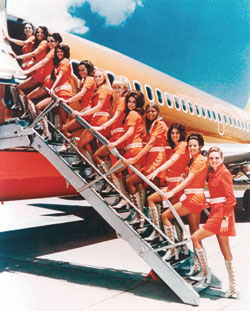
Courtesy of Southwest Airline
The global economic downturn has forced many companies to make deep cuts to their work forces. Numerous retailers like Mervyn’s and Circuit City Stores Inc. closed locations, filed for bankruptcy or shut down altogether. Even companies like Yahoo!, Google, American Express and Motorola have had to cut their work forces.
The dramatic downturn in the economy left many organizations in a quandary. Several years ago, the major issue was winning the so-called war for talent: how to attract and retain the best and brightest. So companies implemented rigorous selection mechanisms, internal promotion ladders, extensive training and development, flexible work scheduling and group incentive schemes, all in hopes of developing a work force that would confer a sustainable competitive advantage. But then the recession turned that thinking upside down. Many organizations have been scrambling to figure out how best to restructure and cut costs without jeopardizing the valuable human capital that they had built.
To help such companies, we have developed a framework that integrates the seemingly paradoxical practices of talent management and downsizing. The framework looks at two important variables: the type of downsizing (reactive versus proactive) and the company’s approach to managing employees (control oriented versus commitment oriented). By first understanding an organization’s position with respect to those two dimensions, managers can devise an optimal strategy for downsizing.
Two Important Dimensions
Of course, downsizing is not a new phenomenon. In fact, over the past two decades it has become a widespread tool for cutting costs and achieving operating efficiencies. Yet past research has shown that downsizing does not guarantee any performance returns.1 Instead, layoffs often result in employees’ broken trust, increased burnout and decreased morale.2 Hence, companies need to understand how to manage the process of work force reduction to attain its benefits while avoiding its ancillary costs.
The Leading Question
When crisis forces down-sizing, is there a best way to do it?
Findings
- Downsizing initiatives must align with talent management strategy.
- Is the downsizing reactive or proactive? Is your organization control oriented or commitment oriented?
- Sometimes core and support workers are managed differently.
There are two basic types of downsizing: reactive and proactive.
References
1.K.P. De Meuse, T.J. Bergmann, P.A. Vanderheiden and C.E. Roraff, “New Evidence Regarding Organizational Downsizing and a Firm’s Financial Performance: A Long-Term Analysis,” Journal of Managerial Issues 16, no. 2 (summer 2004): 155-177.
2.K.E. Mishra, G.M. Spreitzer and A.K. Mishra, “Preserving Employee Morale During Downsizing,” Sloan Management Review 39, no. 2 (winter 1998): 83-95; and A.K. Mishra, K.E. Mishra and G.M. Spreitzer, “Downsizing the Company Without Downsizing Morale,” MIT Sloan Management Review 50, no. 3 (spring 2009): 38-44.
3.M.L. Marks and K.P. De Meuse, “Resizing the Organization: Maximizing the Gain While Minimizing the Pain of Layoffs, Divestitures and Closings,” Organizational Dynamics 34, no. 1 (2005): 19-35.
4.R.L. Kane, “Downsizing and HRM Strategy: Is There a Relationship?” International Journal of Employment Studies 6, no. 2 (October 1998): 43-70.
5.Ibid.
6.C. Chadwick, L.W. Hunter and S.L. Walston, “Effects of Downsizing Practices on the Performance of Hospitals,” Strategic Management Journal 25, no. 5 (May 2004): 405-427.
7.J. Brockner, “Managing the Effects of Layoffs on Survivors,” California Management Review 34, no. 2 (winter 1992): 9-28; D.C. Feldman, “Better Practices in Managing Layoffs,” Human Resource Management 33, no. 2 (summer 1994): 239-260; and Mishra, “Preserving Employee Morale.”
8.C.O. Trevor and A.J. Nyberg, “Keeping Your Headcount When All About You Are Losing Theirs: Downsizing, Voluntary Turnover Rates and the Moderating Role of HR Practices,” Academy of Management Journal 51, no. 2 (April-May 2008): 259-276.
9.J. Brockner, “Why It’s So Hard to Be Fair,” Harvard Business Review 84 (March 2006): 122-129.
10.W.F. Cascio and P. Wynn, “Managing a Downsizing Process,” Human Resource Management 43, no. 4 (winter 2004): 159-163.
11.R.D. Iverson and C.D. Zatzick, “High-Commitment Work Practices and Downsizing Harshness in Australian Workplaces,” Industrial Relations 46, no. 3 (July 2007): 456-480.
12.A. Kirshnan, “Worker Shuffles at SAS Again,” July 12, 2006, www.newsobserver.com.
13.D.E. Bowen and C. Ostroff, “Understanding HRM-Firm Performance Linkages: The Role of the ‘Strength’ of the HRM System,” Academy of Management Review 29, no. 2 (2004): 203-221.
14.J. Dickler, “Employers: No Layoffs Here,” December 11, 2008, www.cnnmoney.com; “Southwest Offering Buyouts to Employees,” Associated Press, May 28, 2004, www.usatoday.com/travel/news/2004-05-28-swa-buyouts_x.htm; and M. Esterl, “Will Southwest Lose Some of the LUV?” April 17, 2009, http://blogs.wsj.com/middleseat/2009/04/17/will-southwest-lose-some-of-the-luv/.
15.“Circuit City to Fire More Than 3,400 Workers,” Associated Press (2007); www.vancouversun.com.
16.S. Fallon, “Circuit City Layoffs May Have Contributed to Demise,” October 21, 2008, www.gizmo.com.
17.K. Griffiths, “Wal-Mart Crushes Union by Closing Store,” May 11, 2005, www.commondreams.org.
18.J.A. Chatman, C.A. O’Reilly and V. Chang, “Cisco Systems: Developing a Human Capital Strategy,” California Management Review 47, no. 2 (winter 2005): 137-167.
19.J. Vascellaro and S. Morrison, “Yahoo Revises Contentious Severance Plan,” Wall Street Journal, Dec. 11, 2008, sec. B, p. 1.
20.R. Shenoy, “Idled Workers Occupy Factory in Chicago,” Chicago Tribune, Dec. 6, 2008.
21.C.D. Zatzick and R. Iverson, “High-Involvement Management and Workforce Reduction: Competitive Advantage or Disadvantage?” Academy of Management Journal 49, no. 5 (2006): 999-1015; and Bowen, “Understanding HRM-Firm Performance.”
22.M. Andrews and F. Anderson, “Radical Layoffs at Radical Entertainment,” Aug. 14, 2008, www.vancouversun.com.
23.D.P. Lepak, M.S. Taylor, A.G. Tekleab, J.A. Marrone and D.J. Cohen, “An Examination of High-Investment Human Resource Systems for Core and Support Employees,” Human Resource Management 46, no. 2 (summer 2007): 223-246.
24.H. Weber, “Delta Offers Voluntary Severance” (2008); retrieved January 8, 2008, from http://news.cincinnati.com.
i.E.S. Barnes, “No-Layoff Policy,” July 2003, www.work force.com.
ii.M. Richtel, “More Companies Are Cutting Labor Costs Without Layoffs,” New York Times, Dec. 21, 2008, www.nytimes.com.
iii.F. Gandolfi, “Cost Reductions, Downsizing-Related Layoffs and HR Practices,” SAM Advanced Management Journal (summer 2008): 52-58.
iv.Brockner, “Managing Effects”; Mishra, “Preserving Employee Morale”; and Mishra, “Downsizing the Company.”
v.A. Molinsky and J. Margolis, “The Emotional Tightrope of Downsizing: Hidden Challenges for Leaders and Their Organizations,” Organizational Dynamics 35, no. 2 (May 2006): 145-159.
vi.W. Bridges, “Managing Transitions: Making the Most of Change” (Reading, Massachusetts: Addison Wesley, 1991).
vii.L. Hansen, “Auto Dealing Family Feels the Pinch,” Dec. 7, 2008, www.npr.org (audio).
viii.M.L. Marks, “A Framework for Facilitating Adaptation to Organizational Transition,” Journal of Organizational Change Management 20, no. 5 (2007): 721-739.
ix.J. Brockner, “The Effects of Work Layoffs on Survivors: Research, Theory and Practice,” vol. 10 in “Research in Organizational Behavior,” ed. B.M. Staw and L.L. Cummings (Greenwich, Connecticut: JAI Press, 1988), 213-255; and Brockner, “Managing the Effects.”
Comments (4)
rahul vadya
Why Mass Sackings Don't Work | Lifehacker Australia
Dave
ikinci el prefabrik