


Innovation Strategy
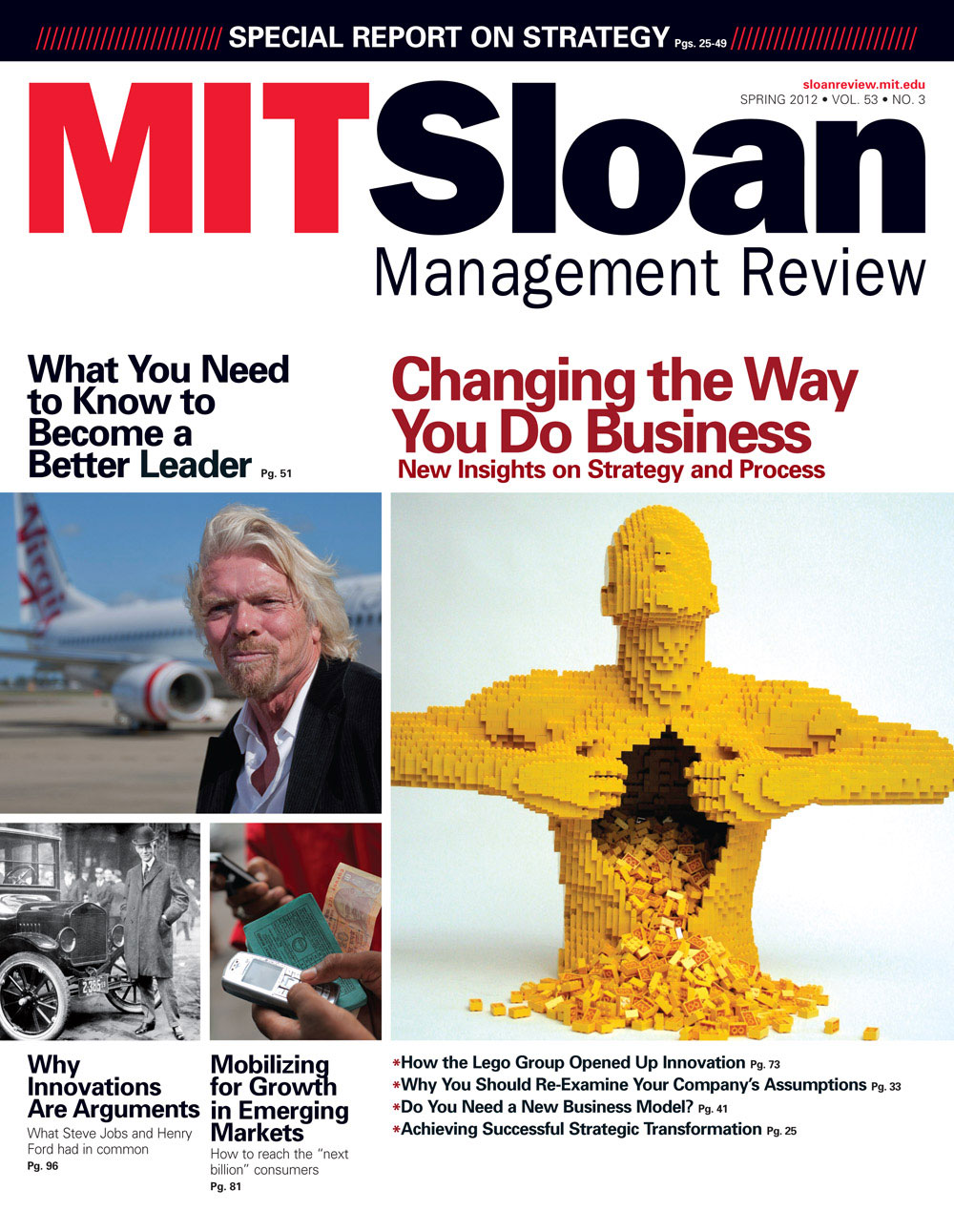
Why Innovations Are Arguments
Too many executives confuse what an innovation is with what an innovation would do for them if they had one.
Randall S. Wright

Innovation Strategy
Collaborating With Customer Communities: Lessons From the Lego Group
For the Lego Group, a close bond with user communities is not a pipe dream but a reality.
Yun Mi Antorini, Albert M. Muñiz, Jr. and Tormod Askildsen

Project Management
Inside the World of the Project Baron
New research offers insights into the leadership — and politics — that typify project-based firms.
David Gann, Ammon Salter, Mark Dodgson and Nelson Phillips

Leadership Skills
How to Become a Better Leader
To grow as an executive, you need to recognize and manage your strongest tendencies.
Ginka Toegel and Jean-Louis Barsoux

Culture
Uncommon Sense: How to Turn Distinctive Beliefs Into Action
A company’s beliefs are often the most critical source of differentiation.
Jules Goddard, Julian Birkinshaw and Tony Eccles

Business Models
Creating Value Through Business Model Innovation
Here are six questions for executives to consider when thinking about business model innovation.
Raphael Amit and Christoph Zott

Business Models
Achieving Successful Strategic Transformation
This article explores the distinctive traits of companies that successfully transform themselves.
Gerry Johnson, George S. Yip and Manuel Hensmans

The Case for Standard Measures of Patent Quality
The current approach to measuring patent quality is not serving the world’s patent systems.
David J. Kappos and Stuart Graham

Global Strategy
Learning How to Grow Globally
New research offers insights into choosing the best approach to learn about a foreign market.
Christopher Bingham and Jason Davis

Developing Strategy
Are CEOs Getting the Best From Corporate Functions?
At too many large companies, corporate functions like HR and IT don’t get enough strategic direction from the CEO.
Andrew Campbell, Sven Kunisch and Günter Müller-Stewens

Technology Innovation Strategy
The Impact of IT Investments on Profits
New research finds that investments companies make in information technology increase profitability and sales more than investments in advertising or R&D do.
Sunil Mithas, Ali Tafti, Indranil Bardhan and Jie Mein Goh

Global Strategy
Mobilizing for Growth in Emerging Markets
To reach the “next billion” consumers, multinational companies need to create new networks of local partners.