
The Rhythm of Change
Topics
We are all familiar with the modern-day manager’s mantra that we live in times of great and constant change. Because the world is turbulent, it is said, and the competition is hyperturbulent, managers must take seriously the job of continually initiating and adjusting to change. Change, by definition, is good. Resistance to change is bad.
Might we suggest that you turn off the hype and look out the window? Do you notice anything out there resembling all that supposed change and turbulence? We perceive our environment to be in constant flux because we only notice the things that do change. We are not as keenly aware, however, of the vast majority of things that remain unchanged — the engine of the automobile you drive (basically the same as that used in Ford Motor Co.’s Model T), even the buttons on the shirt you wear (the same technology used by your grandparents). This, indeed, is a good thing, because prolonged and pervasive change means anarchy — and hardly anybody wants to live with that. Sure, important changes have been taking place recently, but the truth is that stability and continuity also form the basis of our experience. In fact, change has no meaning unless it is juxtaposed against continuity. Because many things remain stable, change has to be managed with a profound appreciation of stability. Accordingly, there are times when change is sensibly resisted; for example, when an organization should simply continue to pursue a perfectly good strategy. What’s needed is a framework whereby pragmatic, coherent approaches to thinking about change can be explored.
Dramatic, Systematic and Organic Change
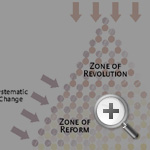
Today’s obsession with change focuses on that which is imposed dramatically from the “top.” This view should be tempered, however, by the realization that effective organizational change often emerges inadvertently (organic change) or develops in a more orderly fashion (systematic change). (See “The Change Triangle.”)
References
1. H. Mintzberg, “Crafting Strategy,” Harvard Business Review 65 (July–August 1987): 66–75.
2. S.J. Mezias and M.A. Glynn, “The 3 Faces of Corporate Renewal: Institution, Revolution and Evolution,” Strategic Management Journal 14 (February 1993): 77–101. Evolution is similar to our rejuvenation, except that it is described as working within the rules; revolution disregards or breaks the rules and so is closer to what we call organic change; and institution is akin to our reform.
3. S.D. Alinsky, “Rules for Radicals: A Practical Primer for Realistic Radicals” (New York: Vintage Books, 1989), xxii.
4. H. Mintzberg, “The Rise and Fall of Strategic Planning” (New York: Free Press, 1994).
5. R. Pascale, M. Millemann and L. Gioja, “Changing the Way We Change,” Harvard Business Review 75 (November–December 1997): 126–139.
6. Q.N. Huy, “Emotional Balancing of Organizational Continuity and Radical Change: The Contribution of Middle Managers,” Administrative Science Quarterly 47 (March 2002): 31–69.
7. S.L. Brown and K.M. Eisenhardt, “Competing on the Edge: Strategy as Structured Chaos” (Boston: Harvard Business School Press, 1998).
8. D. Miller “Organizations: A Quantum View” (Englewood Cliffs, New Jersey: Prentice-Hall, 1984).
9. E. Abrahamson, “Change Without Pain,” Harvard Business Review 78 (July–August 2000): 75–79.
10. Q.N. Huy, “Time, Temporal Capability and Change,” Academy of Management Review 26 (October 2001): 601–623.
Comment (1)
Nelson Caller