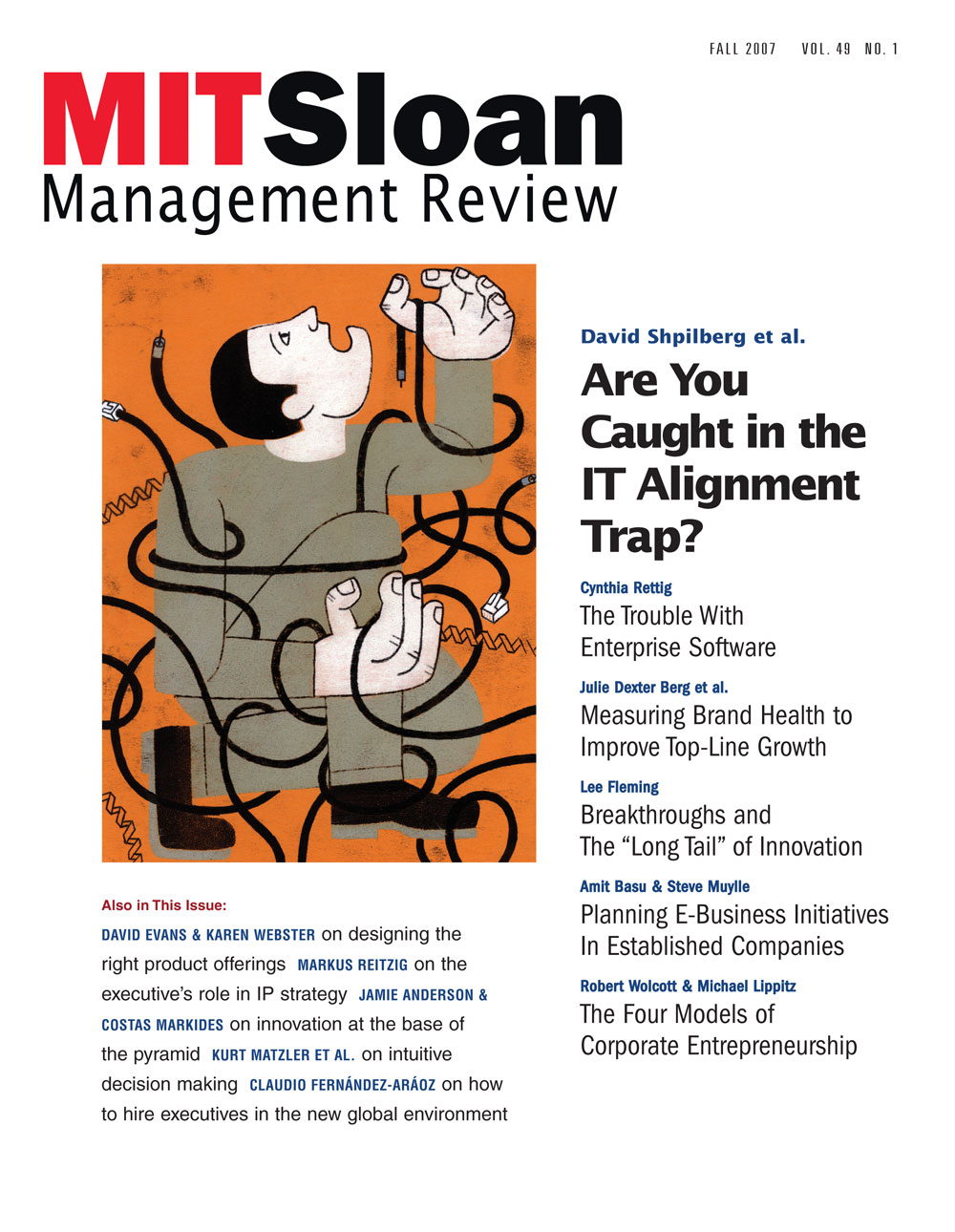
Avoiding the Alignment Trap in IT
- Research Feature
- Read Time: 25 min
Information technology remains a terrible bottleneck to growth in most companies, mainly because executives focus on the wrong remedy for their IT problems
Earlier this year, I participated in a panel discussion on “Leading in a Networked World” at the World Economic Forum in Davos, Switzerland, and made the point that leadership attention is perhaps the networked world’s most scarce resource.
Nearly every organization has rightfully made innovation a priority, and management journals dedicate significant column inches to how to manage innovation.
Marketers cannot avoid discounted sales, and consumers have come to expect them. The average shopping mall, grocery store or online shop is littered with discounted products: Tide detergent is 10% off; books are sold with free shipping; Nike sneakers are buy-one, get-one-free.
Word of mouth is a great way to reach new customers, but it’s an even better way to lose them. At least, that’s what three researchers found when they looked at how the usage patterns of a home video service changed with quality levels.&
With promises of higher shareholder returns, greater stability, better focus on long-term strategies and decreased complexity, classified boards have been offered as a solution to the U.S. corporate governance crisis.
Contrary to conventional wisdom, there is a key set of fundamental metrics — which can be actively managed — linking the health of brand to revenue and consumer commitment.
Companies create product versions from multiple components. The big challenge is how to take the available components and combine them into the product versions and product lines that will maximize profits.
Innovation in developing markets has less to do with finding new customers than addressing issues of product acceptability, affordability, availability and awareness.

At many companies, intellectual property has become an area of focus. Research shows that top-management involvement in IP strategy is associated with better IP performance.
Companies have four ways of building businesses from within their organizations. Each approach provides certain benefits — and raises specific challenges.

Technology has always been about hope. Since the beginning of the industrial revolution, businesses have embraced new technologies enthusiastically, and their optimism has been rewarded with improved processes, lower costs and reduced workforces.
Finding the right individuals to fill executive positions has never been easy, and the process is only getting more difficult with increased globalization.
To understand how breakthroughs in innovation arise, managers first need to be aware of the different factors that shape the highly skewed distribution of creativity.
Despite the welter of data and analytics at their disposal, experienced managers often need to rely on gut instinct to make complex decisions under duress.
Many large and mature firms — which still form most of the economy — have difficulty analyzing the opportunities and difficulties created by the Internet. Here is a planning process, validated at several established companies, that puts e-business into perspective and helps make it manageable.
Conventional wisdom holds that consumers faced with a large product assortment, like PCs with varying processor speeds, would rather choose a product that is middling than one at the extremes.