

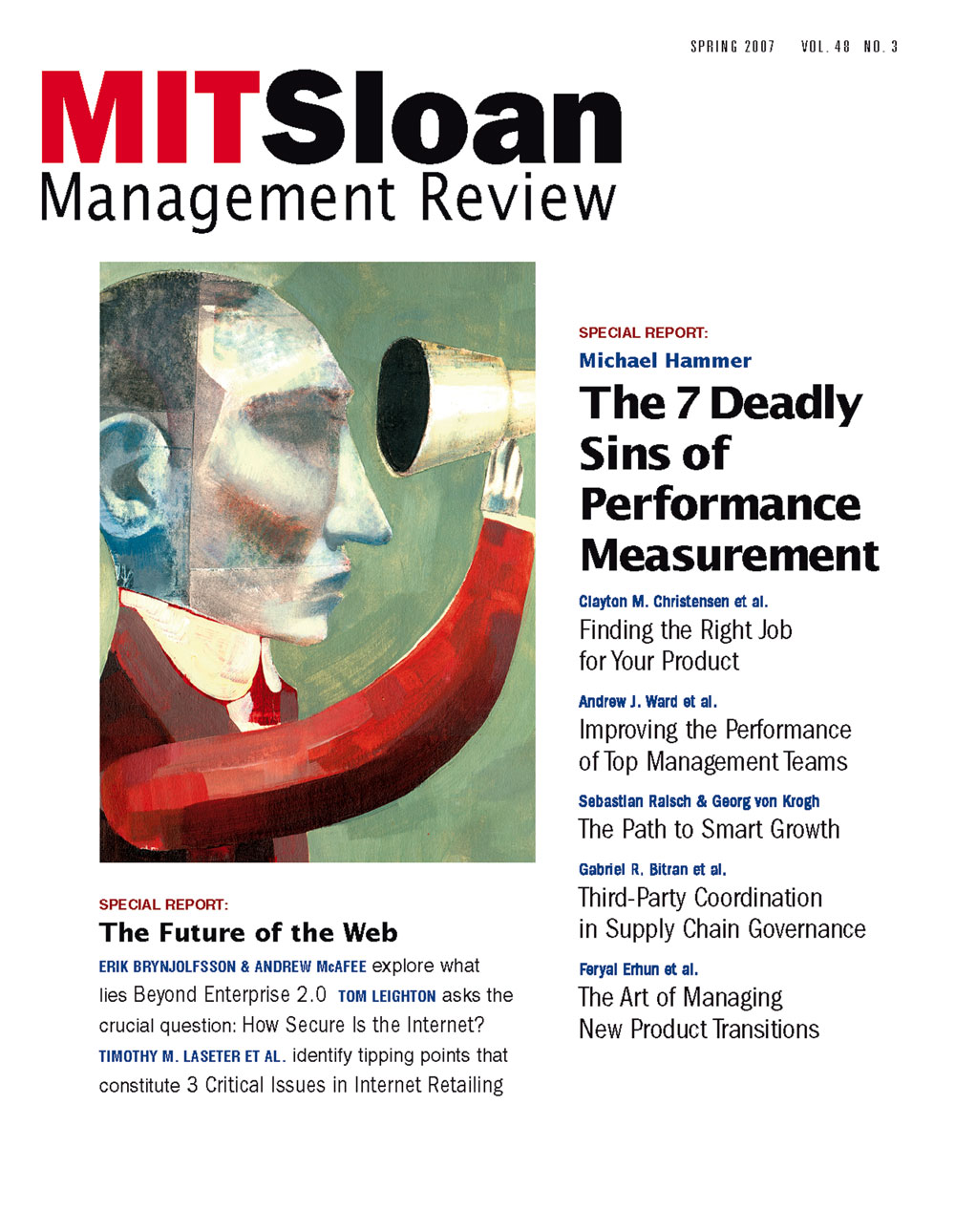



Digital Marketing
3 Critical Issues in Internet Retailing
Managing returns, structuring the physical distribution network and deploying product inventories are all key.
Timothy M. Laseter, Elliot Rabinovich, Kenneth K. Boyer and M. Johnny Rungtusanatham

Financial Management & Risk
Protecting Your Employees’ Retirement
Personal investment puts management at risk.
David Wagner

Developing Strategy
The Five Stages of Successful Innovation
Defining an innovation process increases companies’ future value.
Alissa Mariello

Weakness or Opportunity
Some weaknesses can be addressed with proper effort and resources, while others simply cannot be changed.
John Humphreys

Ethics
Do Stronger Laws Prevent Corporate Crime?
Societal consequences give power to formal sanctions.
Larry Yu

Culture
Corporate Culture in the Numbers
A company’s policies provide insight into its culture.
Larry Yu

Collaboration
The Need for Third-Party Coordination in Supply Chain Governance
Gabriel R. Bitran, Suri Gurumurthi and Shiou Lin Sam


Marketing Strategy
The Art of Managing New Product Transitions
Feryal Erhun, Paulo Gonçalves and Jay Hopman

Marketing Strategy
Finding the Right Job For Your Product
Most companies segment their markets by customer demographics or product characteristics and differentiate their offerings by adding features and functions. But the consumer has a different view of the marketplace. He simply has a job to be done and is seeking to “hire” the best product or service to do it. Marketers must adopt that perspective.
Clayton M. Christensen, Scott D. Anthony, Gerald Berstell and Denise Nitterhouse

Innovation Strategy
In Praise of Resource Constraints
Michael Gibbert, Martin Hoegl and Liisa Välikangas


Collaboration
Improving the Performance of Top Management Teams
Andrew J. Ward, Melenie J. Lankau, Allen C. Amason, Jeffrey A. Sonnenfeld and Bradley R. Agle